About the Project

The ZooTrophy Animal-a-Day project began on October 15th, 2013 as illustrator Angela "LemurKat" Oliver began working her way, systematically but selectively, through the alphabet and presenting, via social media, an illustrated animal to the world. Daily.

All pieces are drawn as 2.5 x 3.5 inch collectible cards, using a combination of polychromos and prismacolor pencils, along with other art materials. Many are still available for purchase ($10) or trade, so drop her an email if anything captures your eye or if there is an animal you wish to request.

It is predicted this project will take her at least two years to complete - with approximately 36 animals being drawn for each letter. She has also used the images to create a collectible hardback encyclopedia series, playing cards and a desk calendar, as well as the ZooTrophy collectible trading card game.
Showing posts with label lineart-to-colour. Show all posts

Saturday, April 9, 2016

#868: Yonahlossee Salamander

The Yonahlossee Salamander is a large species of woodland salamander. He inhabits the southern Appalachian Mountains of North America. Here he favours deciduous woodland, and can be found at relatively high altitudes. During the day he takes cover in damp, shaded areas, becoming most active on humid or rainy nights, when he forages for insects and other invertebrates.  As the weather grows colder, he migrates underground.

Saturday, April 2, 2016

#862: Yellow Bishop

The Yellow Bishop is a small, stocky weaverbird. He occupies vegetated areas, ranging across many of the African countries. His food consists mainly of seed, grain and the occasional insect. During the breeding season, the male's plumage grows in glossy black, with the yellow rump and shoulders. Outside of that time, he dons more dowdy browns and greys, not dissimilar to the female.

Thursday, March 24, 2016

#854: Yabby

The Yabby is a small Australian crayfish, found in freshwater, such as streams, rivers, reservoirs and dams.  He can be found in ephemeral pools and can lie dormant for several years in dry conditions. Nocturnal, he feeds on detritus such as algae, plant matter and decaying animal matter. During the summer months he becomes more active, and fishing for yabbies - using a piece of meat tied with string - is a popular activity. As he is Vulnerable to extinction, catch size restrictions are in place.


Friday, February 12, 2016

#817: Warbler

Like many bird Families, Warblers can be divided up into New World, Old World and Australian, with none of the types being especially closely related to the others. Generally speaking, Warbler are passerines characterised by their diminutive stature, relatively dull colourations and musical voices.

The Old World Warblers are spread across Asia, Africa and Europe. Once considered part of one Family, they are now divided into a multitude and this fellow, the Willow Warbler, is one of the "leaf warbler" Family. All species are insectivorous, and the Willow Warbler hawks his food in flight.  Other species may glean them from the canopy.


Sunday, January 17, 2016

#791: Velvet Gecko

Velvet Geckos are a Genus of gecko endemic to Australia. They are arboreal and nocturnal, patterned in a cryptic but colourful shades that provide camouflage during the day. As night falls, he ventures out to hunt for invertebrates, and may even consume smaller geckos. Habitat varies, from caves to spinifex fields, woodland to rock face. Like other geckos, the Velvet Gecko cannot blink, and must lick his eyes to keep them moist.

Monday, January 4, 2016

#778: Uma

As I near the end of the alphabet, you will notice that I start to "cheat" a little. Until now, I've more-or-less avoided scientific names, unless the critter has no common name - but there are precious few creatures beginning with U - and even less with X.

This fellow is an Uma, a Genus of fringe-toed lizards. There are six species, who occupy the low desert areas of North America. They are named for the fringe of scales along their hind toes. These help the lizard to move swiftly across the shirting sand dunes of his desert home. He is specialised in other ways too: his upper jaw overlaps the lower, he can close his nostrils and flaps close his ear openings. His upper and lower eyelids interlock. These adaptations stop the intrusion of sand into his body.

Monday, December 21, 2015

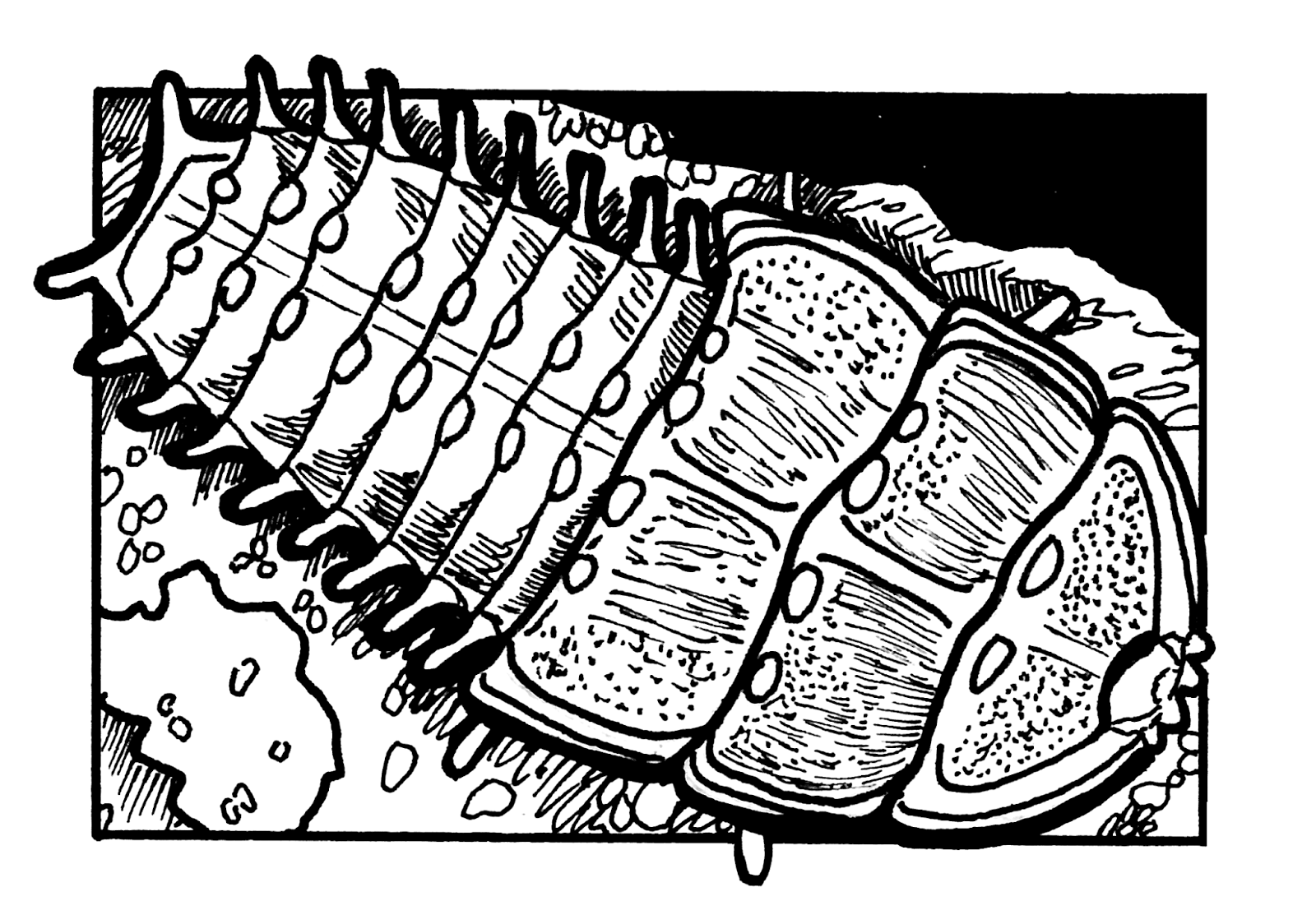
#766: Trilobite Beetle

Trilobite Beetles are named such for their superficial resemblance to the prehistoric, extinct arthropod.They can be found in the rainforests of India and South-east Asia. Females remain in this form - the larval form - for their entire life, whereas males become actual beetles. Preferred habitat is leaf litter, and very little is actually known about them - including the diet, which may be other arthropods or decaying plant matter. Mating is a one-time affair for the male, who dies shortly afterwards, whilst the female goes on to lay around two hundred eggs, then dies a few weeks later.

Sunday, December 20, 2015

#765: Tree Frog

There are numerous species of Tree Frog, a term given to any species that, as an adult frog, follows an aboreal lifestyle. Probably the most recognisable is this Red-eyed Tree Frog of Central America. These red eyes act as a deterrent to predation, for he opens them wide if danger nears, suprisingly any potential predator and giving the frog the opportunity to free.

Thursday, December 17, 2015

#762: Titmouse

The Tufted Titmouse is a diminutive songbird found in the eastern United States. He is common in both the urban environment and deciduous woodlands. While he mainly eats insects, he also forages for seed, nuts and berries, and the popularity of bird feeders in gardens is helping him to spread north. curious by nature, he is known to peek through windows to investigate what's behind. Nests are build in natural tree cavities, lined with soft materials - including fur plucked directly from dogs.

Tuesday, December 15, 2015

#760: Timneh Parrot

The Timneh Parrot is closely related to the African Gray Parrot and until 2012 was regarded as a subspecies. He is slightly smaller, and has more of a maroon tinge to his feathers. Like the African Gray he is intelligent and vocal, and a superb mimic. This has earned him favour in the pet trade, and with the African Gray on the decline (entire populations have been extirpated due to poaching), it is likely he will be the next target. His natural habitat is dense forest.

I know I've said this before, but parrots do not make good pets. Unlike cats and dogs, parrots have not been domesticated; many are either wild-caught or have recent ancestors that are wild-caught. They are social and demanding and need a lot of care and attention. In some cases, demand exceeds the captive-born supply, and poaching is rampant. African Grays are disappearing fast, the Timneh is likely to be next. Being long-lived and intelligent, if you own a parrot, you will need to think of what will happen if you outlive it. They get jealous easily and tend to fixate on one person. Captive born birds that are bonded or imprinted to humans are unlikely to breed. Rescue facilities in the US are full-to-bursting with parrots that have been surrendered because they're too noisy, too needy, too emotionally screwed up, to remain with their human "mate". It's heart-breaking. If you do want a parrot - consider adopting one of those.

Sunday, December 13, 2015

#758: Tiger Salamander

The Tiger Salamander is one of the Mole Salamanders. He lives in North America. Whilst the larvae are aquatic, the adults are terrestrial and live in burrows. His diet consists predominantly of worms and small insects, but he is also known to eat baby mice and smaller amphibians. Juvenile Tiger Salamander resemble axolotls and if terrestrial conditions are not suitable, some may become sexually mature while still in the larval form. This is known as Neoteny. 


Friday, December 11, 2015

#756: Thylacine

The Thylacine was a large carnivorous marsupial, named the Tasmanian Tiger for his striped hide. He is an example of convergent evolution - being a dog-like predator related to the Tasmanian Devil and the Quoll. Unlike most marsupials, both male and female had a pouch: the male's acting to protect his external reproductive organs in his thickly forested home. He had a very large gape, capable of opening his jaws to 120 degree angle.  Already extirpated from the mainland due to competition with the introduced Dingo (as well as disease), his last refuge was the island of Tasmania. Early settlers decided that he posed a threat to their lifestock, and set about diligently eliminating the species.  The last wild speciman was shot in 1930, and the last captive died in 1936.
 
There are a surprisingly large number of unconfirmed Thylacine sightings, both in Tasmania and south-east Australia. Thylacine can be distinguished from a dog by his long, stiff tail which is held more akin to that of a kangaroo's, and an awkward gait (described by one maybe-sighter as "resembling bad CGI"). I know I am not alone in hoping that there are still some of this strange carnivorous kangaroo-like creature roaming the wooded areas of Australia. And, indeed, would dearly love to have my own own unconfirmed sighting to add to the list. Maybe next year, when we go to Tasmania...
http://www.thylacineresearchunit.org/sightingreports.htm

Wednesday, December 9, 2015

#754: Thorny Devil

The Thorny Devil is an Australian lizard, named for the spiny protrusions that cover her body. These not only protect her from predation, but also collect condensation overnight. Her body is covered in hygroscopic grooves, which channel the water into her mouth. She inhabits arid scrubland and desert and lives on a diet of ants - consuming thousands in a day. Eggs are laid in a burrow, and hatch after a few months.

Tuesday, December 8, 2015

#753: Terrapin

Terrapin is the name given to several species of small turtle, such as this Diamondback Turtle. Like the dove and the egret, terrapin is a name more of convenience than serving a taxonomical purpose. Due to their small size, they have become fairly popular in the pet industry and Diamondbacks are farmed as food. Diamondbacks are almost entirely aquatic, coming ashore only to breed. Although most Terrapins favour freshwater, the Diamondback lives in the marine environment, although she stays close to shore. To obtain fresh water, she sips rainwater from the surface, or catches it as it falls.

Saturday, December 5, 2015

#750: Tenrec

The Tenrecs are a range of small mammals found in Madagascar and parts of Africa. They have diversed to fill a range of niches, especially on Madagascar. There are aquatic Otter Tenrec, spiky Hedgehog Tenrec, and this vividly coloured Lowland Streaked Tenrec, arboreal species, burrowing species and the rotund and plump Common (or Tailless) Tenrec. Tenrec follow a mainly insectivorous diet, although some also consume fruit. The Lowland Streaked can erect her spines to deter predators. Those around her head are barbed, and can be angled to drive into a predator's face. The ones on her back are not barbed, and are used for communication; she vibrates them to produce a faint start. She can give birth to litters of up to 8 youngsters, the Common Tenrec can manage up to 35.

Friday, December 4, 2015

#749: Teledu

The Teledu, or Sundan Stink Badger, is a mustelid more closely related to skunks than to badgers. Found in Malayasia, he is nocturnal and thus rarely seen. He is also not particularly well studied. His diet is omnivorous, and he uses his claws to dig for worms and other invertebrates, as well as taking eggs and carrion. If threatened, he can spray a foul-smelling substance from his anal glands - it has a range of 15 cm.

Wednesday, December 2, 2015

#747: Tayra

The Tayra is a member of the mustelid Family. found in Central and South America. Her preferred habitat is forest, but she will cross grasslands at night as she moves from one forest patch to the next. She is solitary and arboreal in nature, and can traverse the forest with speed. Her long tail aids in balance and her claws are short, curved and strong. She feeds on fruit and small vertebrates, and also has a taste for honey. Tayra are easily tamed and sometimes kept as household pets to help rid a house of vermin. She does, however, pose a threat to chickens.

Saturday, November 28, 2015

#743: Tanuki

Tanuki is the name given to the subspecies of Racoon Dog found in Japan. He is well known in mythology as mischevious, jolly and a bit of a trickster. The Asian Racoon Dog is a member of the Canine Family, and one of two Canid species that regularly climb trees. His diet is omnivorous and varies with the seasons - fruit, grains, vegetables and eggs in summer, rodents and other small prey in the colder months. Despite having an extremely thick fur coat, he hibernates in winter. This thick pelt has found favour in the fur industry. This has led to the species being introduced into Eastern Europe and Scandinavia, either intentionally or as escapees from fur farms. Whilst in his natural range numbers are declining, in this introduced range, he is at risk of becoming an Invasive Pest.

Friday, November 27, 2015

#742: Tang

Tang are various species of Acanthuridae fish, related closely to Unicornfish and Surgeonfish. This particular species, the Blue Tang, is widespread throughout the Indo-Pacific, but not common anywhere. She is very popular in the aquarium industry, despite following a fairly delicate diet and being prone to parasitic infections. She feeds on algae and plankton. When she is ready to breed, her colour lightens to a pale blue. Males will court her aggressively, rushing to release their sperm into the water with her eggs. These float upwards, attached to a bubble of bouyant oil. These will hatch in a day into tiny transparent larvae.

If she looks familiar, that's because she's Dory from "Finding Nemo". Look, I found her!