About the Project

The ZooTrophy Animal-a-Day project began on October 15th, 2013 as illustrator Angela "LemurKat" Oliver began working her way, systematically but selectively, through the alphabet and presenting, via social media, an illustrated animal to the world. Daily.

All pieces are drawn as 2.5 x 3.5 inch collectible cards, using a combination of polychromos and prismacolor pencils, along with other art materials. Many are still available for purchase ($10) or trade, so drop her an email if anything captures your eye or if there is an animal you wish to request.

It is predicted this project will take her at least two years to complete - with approximately 36 animals being drawn for each letter. She has also used the images to create a collectible hardback encyclopedia series, playing cards and a desk calendar, as well as the ZooTrophy collectible trading card game.
Showing posts with label invertebrate. Show all posts

Friday, March 11, 2016

#842: Woodlouse

Woodlice are isopodic, (mostly) terrestrial crustaceans with many names, including slaters (which is what we always used to call them, here in NZ) and pill bugs. The latter cames from the ability of some species to roll themselves up into a protective ball when threatened. This fine speciman is a rosy woodlouse, her species ranges from the British Isles to North Africa. The female woodlouse carries her eggs in a special pouch on her underside. These hatch into white, miniature versions of the adult. She is generally found in damp, dark places where she feeds on decaying plant matter.

Tuesday, February 9, 2016

814: Walpole Burrowing Crayfish

The Walpole Burrowing Crayfish is one of five burrowing crayfish species in the engaewa Genus, all of which are found in the southern corner of Western Australia. Walpole Burrowing Crayfish occurs in a very limited range, and as such is classified as Endangered. This tiny crayfish grow up to 50mm in length. He inhabits peat moss, swamps, and other areas with a heightened water table, but does not live under water.

Wednesday, January 20, 2016

#794: Velvet Worm

There are 180 species of Velvet Worm, found in tropical and southern temperate habitats. It is thought that he hasn't changed much in 500 million years. Unlike arthropods, he lacks a hard exoskeleton and is instead covered in tiny scales, giving him a velvety look and providing a waterproof covering. He is prone to dessication, and favours moist humid habitats. Carnivorous in diet, the Velvet Worm is an ambush predator, squirting his prey with slime to subdue it, before injecting saliva that dissolves the prey's insides.

Saturday, January 9, 2016

#783: Urchin

The Urchins are around 950 species of marine echinoderms. He is characterised by his symmetry and spines, which protect him from predation. They are dioecious, with individuals being either male or female. Males tend to live in more elevated and exposed positions, whereas females favour low-lying locations. Urchins feed on algae, which is consumed through an orifice in his lower half - this acts as both mouth and anus. It is studded with calcium carbonate "jaws" and features a fleshy tongue-like structure. Whilst Urchins have no apparent eyes, his entire body is a sensory organ and sensitive to touch, light and chemicals. Locomotion is slow, but achieved by adhesive tube feet.

Monday, December 21, 2015

#766: Trilobite Beetle
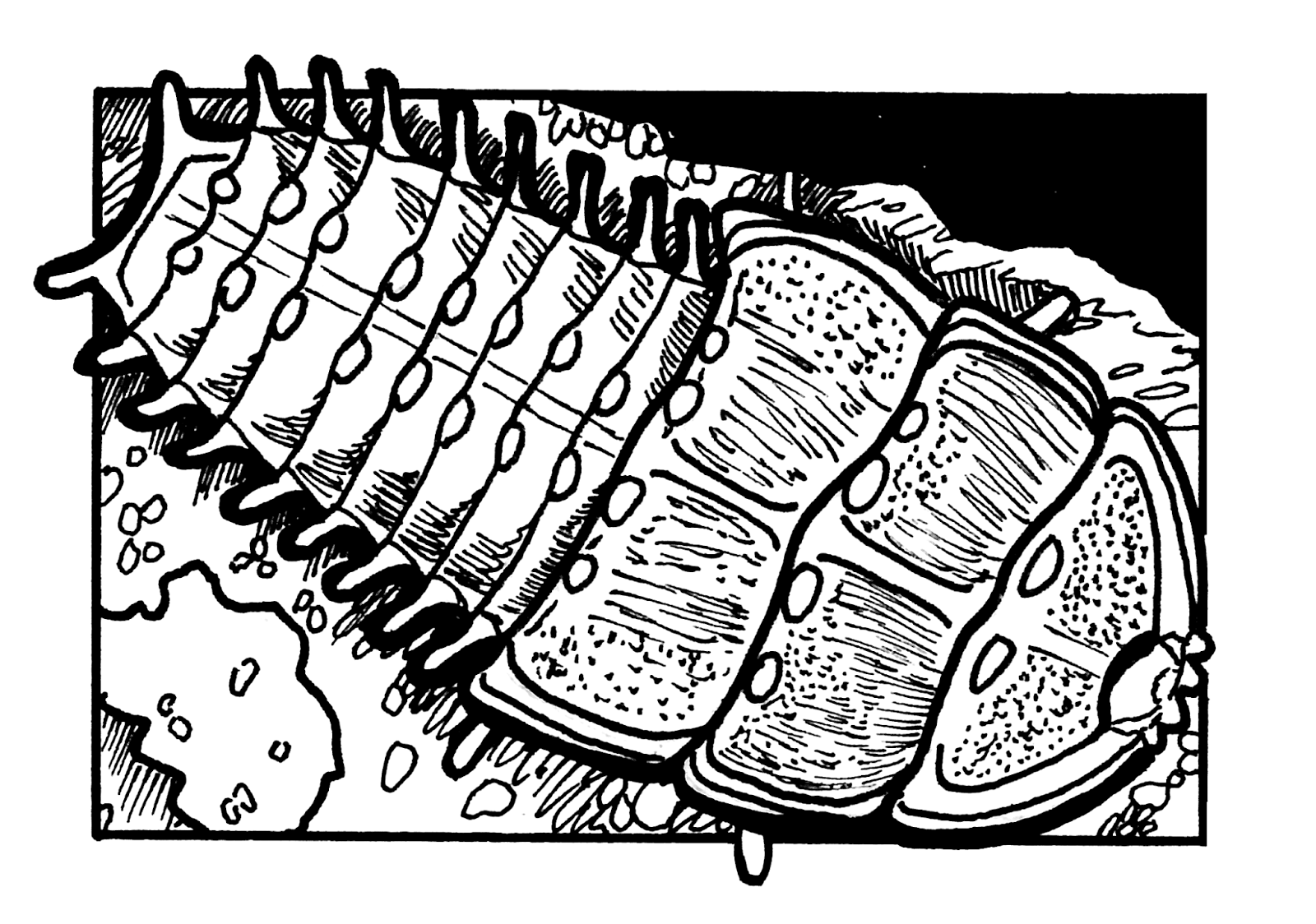
Trilobite Beetles are named such for their superficial resemblance to the prehistoric, extinct arthropod.They can be found in the rainforests of India and South-east Asia. Females remain in this form - the larval form - for their entire life, whereas males become actual beetles. Preferred habitat is leaf litter, and very little is actually known about them - including the diet, which may be other arthropods or decaying plant matter. Mating is a one-time affair for the male, who dies shortly afterwards, whilst the female goes on to lay around two hundred eggs, then dies a few weeks later.

Monday, November 30, 2015

Creature Feature #745: Tarantula

There are approximately 900 species of Tarantula, with a range that encompasses much of the tropics and subtropical regions. The smallest species is the size of a fingernail, the largest as big as a dinner plate. These hairy arachnids come in a variety of colours, with brown being popular, but there is also the brilliant blue Peacock Tarantula, and various other species, including this Mexican Red-kneed Tarantula. Some species are aboreal, others terrestrial. All are predators, using ambush techniques to hunt their prey - which ranges in size from tiny insects, up to lizards, mice and even birds, depending on the species (and the size).

Tarantulas are sometimes kept as pets. They  are all venomous, but there are no recorded fatalities from being bitten. Once again, the venom varies across species - some being no worse than a wasp sting, others causing muscle cramps, severe pain and hallucinations.

Saturday, November 7, 2015

#722: Starfish

Starfish are echidnaderms, named for their star-like shape. About 1,500 species can be found worldwide, living on oceanbeds ranging from the frigid polar waters to the tropics. Starfish are predators, feeding on benthic invertebrates. The more primitive species swallow their prey whole, digesting it internally and ejecting out the inedible parts. Advanced species actually evert part of their stomach, forcing it into the bivalve prey, and digesting it from the inside-out, outside its body. In many species, gender is a fluid concept, with some being gendered, others simultaneous hermaphrodites and some being sequential hermaphrodites and changing gender as they age. Like many relatively sessile invertebrates, larvae are free-swimming. Their diet consists of phytoplankton. They are also able to reproduce asexually, by losing one of thier arms, which then sprouts into a new Starfish.

The Northern Pacific seastar (which I might have to draw instead of this one) has been introduced to Australian waters, where it is a voracious predator doing significant damage to the marine environment. It is ranked on the list of Invasive Pests.

Wednesday, November 4, 2015

#719: Squid

The Squids are around 304 cephalapod species, characterised by their elongated mantles. Squids range in size from 60 cm, to the 14 m Colossal Squid - the largest invertebrate in the world. Like their cousins, the Cuttlefish, Squid have four pairs of legs and two tentacles. In the males of many shallow-water species, two of these legs are modified into reproductive organs. Deep-water Squid, on the other hand, have the longest penis in relation to body size of any moblie animal (the only one longer belongs to the sessile Barnacle).
This fellow is probably a Reverse Jewel Squid.

Tuesday, October 20, 2015

#704: Slug

Slug is a name given to apparently shell-less gastropod molluscs. They lead a mostly terrestrial existence, and are prone to dessication - hence they favour a moist environment such as leaf litter, or beneath rocks. Many retain a remnant of their ancestral shell, although this is often internal. Slugs move using their flat underside - known as the "foot". By contracting the muscles and exuding a layer of mucus, they are able to move at a slow but steady pace. This mucus also aids in retaining moisture. Slugs are hermaphrodites and able to reproduce as both male and female. With some species - like this Banana Slug - the penis becomes trapped within the partner's body and must be chewed off before they can separate. After that, the Slug is only able to mate as a female.

Tuesday, September 29, 2015

#690: Sea Squirt

Sea Squirts are sedentary Tunicates, firmly fixed to rock, coral or some other substrate. They are named for their tunic-like rigid covering, which is composed of living tissue. The upper surface contains two siphons, which violently expels water when the animal is removed from its environment, hence the common name of "squirt". The upper, larger, siphon contains cillia, which suck in the water, removing the nutrients and expelling the rest out of the lower siphon. Sea Squirts are hermaphrodites, and fertilisation is external. Juvenile larvae are free-swimming, but within 36 hours will have settled into a sessile lifestyle.

Saturday, August 29, 2015

#669: Roundworm

There are perhaps as many as 1 million species of Roundworm, a Phylum of Nematode, over half of which are parasitic. Widespread and versatile, various species inhabit every ecosystem from the deepest oceanic trenches to the driest deserts. They are also, most famously, known to occupy the internal organs of vertebrates, but species are also adapted to parasitise plants and insects as well. Long and slender, parasitic Roundworms have a distinctive head, which may contain head shields and three or six lips, equipped with an array of teeth. They may also be ornamented with bristles, ridges and other distinctive structures. Eggs are deposited in the soil via the host's fecal matter, where they can be ingested directly, or indirectly, by a new host. Once hatched, the larvae may affect the host's behavioural patterns and can have a detrimental effect on their health.

Sunday, June 7, 2015

Creature Feature #590: Pinwheel

The Dlinza Pinwheel is a strange and beautiful snail, characterised by the bristles radiating from their almost translucent shell. They are found only in the Dlinza forest, in South Africa, an area that measures only 250 hectares. Preferred habitat is coastal scarp forest, where they can be found beneath the low-level leaves, within the leaf litter and under decaying logs. Although the forest is protected, it lies within an area of urban development and the snail is very vulnerable to habitat disturbance and weather fluctuations.

Friday, May 22, 2015

Creature Feature #574: Peacock Jumping Spider

The Peacock Spiders are a Genus of Jumping Spider found in Australia. The male performs an elaborate courtship dance where he raises their third pair of legs and their abdomen, flashing their brightly colours to attract a mate. He inhabits low bushes and the ground, and like all Jumping Spiders follows a nomadic lifestyle, stalking and hunting insect prey.

If you're really lucky, you might get a second peacock spider tomorrow. Otherwise it'll be an actual peacock!

Thursday, April 30, 2015

Creature Feature #558: Oyster

Oyster is the common name given to various Families of clam, found in both marine and brackish waters. They are filter feeders, drawing water in through their gills and straining it of nutrients, which are then trasnported to the mouth. Each Oyster is capable of filtering up to 5 litres of water an hour, improving the water quality of their environment. Many species of Oyster are harvested for the food industry, with the internal organs being considered a delicacy and reported to have aphrodisiac properties. They are high in zinc and other nutrients, whilst also being low in calories.

Friday, April 17, 2015

Creature Feature #545: Oahu Tree Snail

This fellow is an Oahu Tree Snail. They are one of 41 species of large land snail found only on the island of Oahu, Hawaii. They are beautiful - like living jewels. Found in the moist and dry forests, particularly of the mountainous regions, they climb the trees, grazing on fungus. Of these 41 species, some may well be extinct and the others are critically endangered. Why? Because they are predated by introduced pests such as chameleons, rats, and carnivorous rose snail, which was introduced to eliminate the giant land snail (an agricultural pest and thus a herbivore). Unfortunately, the native snails proved tastier and easier to catch - and many species were literally eaten to extinction.

Saturday, April 11, 2015

Creature Feature #539: Orb-weaver Spider

Orb-weaver Spiders are a large Family of arachnids, named for their spiral-shaped webs.These webs are an engineering feat, created first by floating a thread on the wind to a nearby anchoring point, then securing it and making a Y shape, upon which the rest of the structure follows. Non-sticky radii are created next, enabling the spider to manouvere about her web without becoming stuck, as she adds in the adhesive layers. She thren retreats under cover and waits for insects to blunder into her web. Once captured she will bite it, paralysing it, then wrap it and store it for future consumption. Every night she eats her web and builds a fresh one.

This is an Autralian Garden Orb-weaver Spider. She comes in a variety of sizes, colours and shapes and is found in gardens all over Australia.

Not that long ago, I watched a spider succesfully subdue a bee, a complicated dance involving much darting forward and throwing silk, then dodging out of the way of her stinger. Eventually the bee weaked and the spider wrapped her up thoroughly, snipped the threads holding the bundle in place and dragged her up to store under the guttering. It was impressive to watch. Someone later suggested that I should have saved the bee - I would like to say that a, we do not interfere with nature and b, it was already pretty sluggish when I began watching the show. A short while later, someone washed our windows and destroyed the web in the process, but luckily the spider had her food and retreated into safety, thus could be back the next day to create another one.

Thursday, March 19, 2015

Creature Feature #516: Nudibranch

Nudibranch are a Clade of soft-bodied molluscs, living in the marine environment. There are over 2,300 species recognised and they are all remarkedly strange and colourful. In many cases this colour acts as a warning, for many species of Nudibranch are distasteful or poisonous. All known species are carnivorous, and feed on sponges, hydroids and other primitive marine animals, with some species even seeking larger and toxic prey (like our old friend, the Blue Angel, which feeds on Portugese Man 'o war). CAnnibalism is not unknown, either. Nudibranch are hermaphroditic, but cannot self fertilise.

Sunday, January 25, 2015

Creature Feature #463: Millipede

The Millipede is a many-legged Myriapod, related to the Centipede. Unlike its lesser-legged cousin, the Millipede feeds on a diet of decaying vegetation and occasionally emergent seedlings. They are considered to be one of the earliest life forms to colonise the land. Numerous species currently exist, measuring from 2mm to almost 40cm in length. Unable to bite or sting, if threatened the millipede will curl up and secrete chemicals through holes along his body. These burn the exoskeletons of invertebrates and skin and eyes of vertebrates. However, many mammalian predators - such as coati and meerkats - will roll the Millipede on the ground to clean it of the toxins and black lemurs even bite the Madagascar Fire Millipede to activate this defense mechanism, before rubbing it across their fur to act as an insecticide.

This is the Madagascar Fire Millipede. It is not uncommon in the pet trade.
Here is video of one in Perinet: https://www.youtube.com/watch?v=S3PPY3v3hdg

Monday, January 12, 2015

Creature Feature #450: Mantis Shrimp

Mantis Shrimps are  powerful crustaceans and some species can measure over 30 cm in length. They come in a variety of colours, and are very important marine predators. They are characterised by their front claws which come in two varieties: spearers and smashers. When hunting, the Mantis Shrimp strikes his prey with rapid speed and astonishing force - so strong that they have been known to smash through the glass of aquariums. The speed of the strike is so great that not only is the prey struck with the appendage, it is also struck with a cavitation bubble caused by the force generated (which essentially creates a shock wave). The Mantis Shrimp also has elaborate eyes, the most complex in the animal kingdom.


Tuesday, December 23, 2014

Creature Feature #430: Lobster

The Lobster is a marine Crustacean, with a long body, muscular tail and equipped with an impressive pair of chelae (claws).* He lurks in burrows or crevices on the sea bed, feasting on live prey such as molluscs, annelids, fish and occasionally plant matter. Cannibalism is not unknown, especially in captivity. Lobster are long-lived, and may reach 70 years of age, growing in size as they age. Older Lobsters may be more fertile than younger ones. Lobster are highly valued as a food source by humans, although the eating of them was considered a mark of poverty until well within the twentieth century when they suddenly became regarded as a delicacy.

 This is a European Lobster.


* The clawless Spiny Lobster are not closely related and shall be dealt with independently.