About the Project
The ZooTrophy Animal-a-Day project began on October 15th, 2013 as illustrator Angela "LemurKat" Oliver began working her way, systematically but selectively, through the alphabet and presenting, via social media, an illustrated animal to the world. Daily.
All pieces are drawn as 2.5 x 3.5 inch collectible cards, using a combination of polychromos and prismacolor pencils, along with other art materials. Many are still available for purchase ($10) or trade, so drop her an email if anything captures your eye or if there is an animal you wish to request.
It is predicted this project will take her at least two years to complete - with approximately 36 animals being drawn for each letter. She has also used the images to create a collectible hardback encyclopedia series, playing cards and a desk calendar, as well as the ZooTrophy collectible trading card game.
All pieces are drawn as 2.5 x 3.5 inch collectible cards, using a combination of polychromos and prismacolor pencils, along with other art materials. Many are still available for purchase ($10) or trade, so drop her an email if anything captures your eye or if there is an animal you wish to request.
It is predicted this project will take her at least two years to complete - with approximately 36 animals being drawn for each letter. She has also used the images to create a collectible hardback encyclopedia series, playing cards and a desk calendar, as well as the ZooTrophy collectible trading card game.
Showing posts with label feline. Show all posts
Saturday, December 12, 2015
#757: Tiger
The Tiger is the largest of the Felid Family, with the Siberian subspecies reaching 3.38 m in length. It is he who is truly the King of the Jungle, and he once roamed the forests as far north as Siberia and as far south as Bali. Now his range is more restricted and fragmented due to hunting and deforestation. He is solitary, but his range often overlaps that of several females, and will sometimes even share his kills with them (and they with him). His favoured food is medium-sized ungulates, especially deer. An ambush predator, he lies in wait and uses his size and strength to disable the prey, before dispatching it with a bite to the throat.
Saturday, October 24, 2015
#708: Snow Leopard
The Snow Leopard is a large feline who makes her home in the alpine and sub-alpine regions of Central and South Asia. Like most cats, she is solitary in nature. An ambush predator, she stalks along rocky ledges seeking prey, such as markhor, tahr and smaller mammals, on the lower slopes. Whilst related to lions and the other Panthera cats, Snow Leopards are unable to roar. Instead she hisses, chuffs, mews and wails. She has specialised adaptations to the alpine environment, including a thick coat, small ears, wide paws, with furred pads. Her tail is thickened and stores fat. She also has large nasal cavities, allowing better inhalation of the thin mountain air.
Thursday, July 2, 2015
#615. Puma
The Puma, also known as the cougar, is a large feline, found in America. His range extends from Yukon, Canadian to the southern Andes. Highly adaptable and generalistic, he can be found in almost every habitat across his range. Like all cats, he is an obligate carnivore and will feed on everything from insects up to large ungulates, favouring deer and sheep. Solitary and secretive, he comes in contact with the female only long enough to mate and plays no role in raising the cubs.
Sunday, May 10, 2015
Creature Feature #568: Pallas Cat
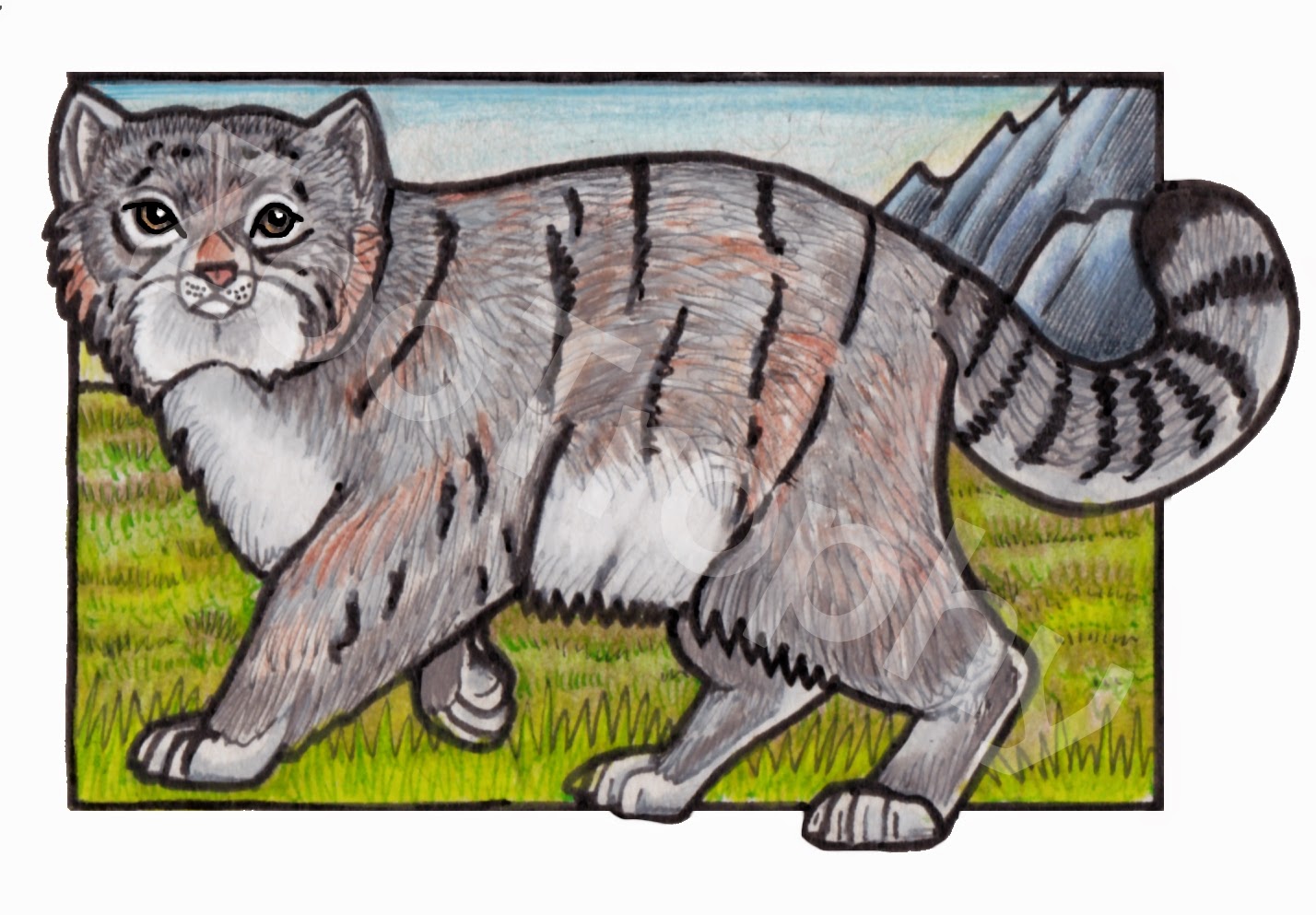
The Pallas Cat is a distinct and very furry feline. He can be found in the grasslands and montane steppes of central Asia. Like most cats, he leads a solitary existence, preying on pika, rodents and ground birds. Due to his cold habitat, the breeding season is very short. Females give birth to up to six kittens in a den lined with vegetation and fur. Even in captivity, the mortality rate of kittens is high - around 45%.
Thursday, April 2, 2015
Creature Feature #530:Ocelot
The Ocelot is a South American wild cat with a range extending through Central America and as far north as Texas. Like most small wild cats he is territorial, nocturnal and generally solitary. His preferred prey is animals smaller than himself: rodents, birds, reptiles and amphibians. He tracks their scent trails but also has strong night vision. Although he only meets up with females long enough to mate, he will sometimes share a his daytime sleeping place with another male Ocelot. Ocelots are occasionally kept as pets - Salvador Dali owned one - but like all non-domesticated exotics, they are unpredictable and can be dangerous or damaging.
Tuesday, December 30, 2014
Creature Feature #437: Lynx
There are four species of Lynx, a medium-sized feline found in North America and Eurasia. She is characterised by her tufted ears and short tail. The more northern species have a thicker pelt and larger paws - adaptations to the colder climate - and her fur is lighter, allowing her better camouflage on the more open, snow-covered landscape. She is solitary in nature, hunting alone for small mammalian and avian prey. The Canadian species feeds almost exclusively on snowshoe hares, whereas her southern cousin, the Bobcat, follows a more varied diet.
Saturday, December 13, 2014
Creature Feature #420: Leopard Cat
The Leopard Cat is a small feline of South and East Asia, named for his spots.Twelve subspecies occur, including the Critically Endangered Iriomote Cat. Like most felids, they are solitary in nature, nocturnal and hunt both on the ground and in the trees. A high percentage of his diet are birds and thus he does not play with his food, instead dispatching it with a pounce and bite. These Cats have been hybridised with domestic cats to produce the Bengal Cat breed.
Friday, December 12, 2014
Creature Feature #419: Leopard
The Leopard is one of the five big cats, and possibly the most adaptable. She makes her home in habitats as diverse as desert and rainforest with her range extending across parts of Africa, Middle East and Asia. An opportunistic hunter, she will prey on anything she can catch - from dung beetles up to chimpanzees and even small gorillas. Solitary in nature, she generally follows nocturnal hunting patterns, although rainforest Leopards are more likely to hunt during the day. To protect her kill from scavengers, she drags it up into the branches of a tree. Sometimes this kill can weigh more than the Leopard herself. Leopards display a range of vocalizations, including purring, which dissudes the factoid I had read somewhere (to be fair, it was probably Willard Price, back in the 1960s) that big cats cannot purr.
If you like Leopards and Africa in general, here's a great comic strip from a very talented illustrator:
http://arven92.deviantart.com/art/Africa-Comic-Cover-388367615
If you like Leopards and Africa in general, here's a great comic strip from a very talented illustrator:
http://arven92.deviantart.com/art/Africa-Comic-Cover-388367615
Subscribe to:
Posts (Atom)


