About the Project
The ZooTrophy Animal-a-Day project began on October 15th, 2013 as illustrator Angela "LemurKat" Oliver began working her way, systematically but selectively, through the alphabet and presenting, via social media, an illustrated animal to the world. Daily.
All pieces are drawn as 2.5 x 3.5 inch collectible cards, using a combination of polychromos and prismacolor pencils, along with other art materials. Many are still available for purchase ($10) or trade, so drop her an email if anything captures your eye or if there is an animal you wish to request.
It is predicted this project will take her at least two years to complete - with approximately 36 animals being drawn for each letter. She has also used the images to create a collectible hardback encyclopedia series, playing cards and a desk calendar, as well as the ZooTrophy collectible trading card game.
Friday, November 8, 2013
Creature Feature #24: Aoudad
The Aoudad, or Barbary Sheep is not in fact a sheep at all, but a goat-antelope. Did you know that antelope and goats are closely related? This regal chap used to roam wild in North Africa, running fleet-footed atop the mountainous peaks in order to evade predators. Now, his numbers are falling in his native range but has proved to flourish elsewhere - such as Spain and North America, where he was released as a game animal.
He lives in arid areas and obtains most of his moisture from the dry grasses and lichens he eats, however if water is available he does enjoy a drink. He is most active in the early morning and the evening, a behaviour known as crepuscular. If threatened, he can jump up to two metres from standing.
Thursday, November 7, 2013
Creature Feature #23: Antpitta
The Antpitta is a relatively small passerine found in the subtropic and tropical regions of South America. This particular species is known as the Black-Crowned Antpitta, for reasons that should be immediately obvious. As his name suggests, he likes to eat invertebrates, and bears a superficial resemblance to the not-closely-related pitta bird. To catch his insect prey, he fossicks about in the leaf litter and hops along the forest floor. Whilst not social with others of his species, he does sometimes hang out near swarms of army ants (which might also explain the name) and will pounce on any prey that they flush out.
Wednesday, November 6, 2013
Creature Feature #22: Anteater
The weird-looking Giant Anteater is a large insectivore found in South America. He can grow up to 217 cm in length and weighs up to 41 kgs. Unlike other anteater species, he is terrestrial. His front claws are long, sturdy and large - perfectly adapted for tearing apart ant and termite nests. To keep them sharp, he curls them back as he walks, putting his weight on his knuckles. Other adaptations to this insect diet include the long snout, lack of teeth andvery limtied jaw movement. His tongue is about 60cm long and covered in short, sticky hairs.
The long bushy tail doubles as a blanket at night.
Tuesday, November 5, 2013
Creature Feature #21: Alligator
Another cold-blooded American, the alligator is found in swampy regions of the southeast of North America. He can grow up to 15 feet in length and has a broader snout than his neighbour, the American Crocodile, also overlapping jaws (when his mouth is closed, the edge of his upper jaws covers his lower teeth) and is darker in coloration. He has between 74 and 84 teeth - although it is a very brave man who counts them, at least on a live 'gator.
He makes his own swimming pool by modifying his swampland habitat - these are known as "Alligator Holes" and are very useful in the drier seasons as a home for small aquatic animals. Larger ones will swiftly find themelves on the menu, as the alligator is a carnivore and will eat anything he can catch - including birds that land near the water's edge. On warm nights, he may hunt climb out of his hole to go hunting, waiting to ambush animals that might come down to the water for a drink.
Monday, November 4, 2013
Creature Feature #20: Anole Lizard
Anolis are a genus of lizards comprising of nearly 400 species. This fellow is the Green, or Carolina, Anole and is the first lizard to have his entire genome sequence. He makes his home in the lower east coast of North America - the Carolinas, Florida, Georgia and as far south-west as Texas, as well as being introduced to Hawaii. So territorial is this wee reptile, that he will even attack his own reflection. His favoured diet is small invertebrates that hop or squirm - worms, crickets, and occasionally he will also eat grasses.
Sunday, November 3, 2013
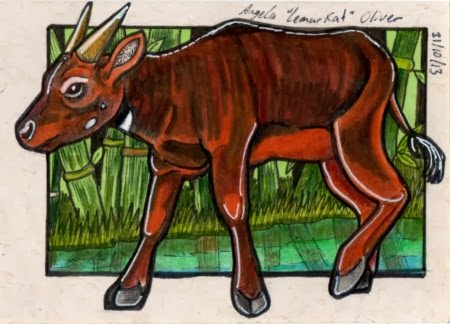
Creature Feature #19: Anoa
This miniature buffalo lives in the rainforests of Sulawesi and Buton, Indonesia.It only grows to 30 inches at the shoulder, which is 76 cm meaning they are about as tall as a large goat, but are much stockier, weighing up to 300 kg.
Unlike most cattle, they live solitary or in pairs although the females do gather into small herds when they are about to calve. Calves are born covered in a thick fur that thins as they mature (in lowland anoa), showing the skin beneath quite clearly. the mountain anoa remains hairy throughout its life.
Both the male and female have horns.
Saturday, November 2, 2013
Creature Feature #18: Ani
This strange looking bird is a member of the cuckoo family. Although, unlike other cuckoos, she is social and shares her territory with up to five other breeding pairs. Her eggs are laid into a communual nest, and all the birds take turns incubating and feeding the chicks. Gregarious and noisy, her and her fellow flock mates like to hang out in pastures, where they eat the insects disturbed by the livestock. She also enjoys a diet of termites, frogs, large insects and lizards. Her native home is the grasslands and open terrain of South America, but her kin have been gradually making the move north, into the United States.
The "Creature Feature" will be erratically on hiatus over the month of November, as I am penning a novel for NaNoWriMo - this does not mean we shall be entirely without art, but it may not be daily. We shall resume again fully in December, at which point I shall hopefully be up to "B".
Subscribe to:
Posts (Atom)