About the Project

The ZooTrophy Animal-a-Day project began on October 15th, 2013 as illustrator Angela "LemurKat" Oliver began working her way, systematically but selectively, through the alphabet and presenting, via social media, an illustrated animal to the world. Daily.

All pieces are drawn as 2.5 x 3.5 inch collectible cards, using a combination of polychromos and prismacolor pencils, along with other art materials. Many are still available for purchase ($10) or trade, so drop her an email if anything captures your eye or if there is an animal you wish to request.

It is predicted this project will take her at least two years to complete - with approximately 36 animals being drawn for each letter. She has also used the images to create a collectible hardback encyclopedia series, playing cards and a desk calendar, as well as the ZooTrophy collectible trading card game.

Friday, November 7, 2014

Creature Feature #384: Kiskadee

The Kiskadee is one of the largest Tyrant Flycatchers. He inhabits America, southwards from Texas and down through into central Argentina. Bold and brash, he is a common sight and has happily colonised urban areas. An opportunistic omnivore, he will pounce on rodents and insects, as well as  plucking fruit from the branches. To protect his territory, he aggresively mobs any raptors that might pass over, calling loudly in the process and thus alerting any potential prey to the presence of the predator.

(I'm not sure who wrote the wikipedia article for this bird, but they have a slightly pretentious edge to their tone, which makes it rather a delight to read).

Thursday, November 6, 2014

Creature Feature #383: Kinkajou

The Kinkajou is a small, arboreal mammal that makes her home in the rainforests of Central and South America. Although she falls in the the Order Carnivora, she favours a frugivorous diet and particularly enjoys figs. When eating fruit, she holds it in her paws, scooping out the pulp with her 12 cm long tongue. She uses her prehensile tail to assist her in climbing and will occasionally hang from it. During the day she sleeps in tree hollows, coming out at night to scramble through the trees, and thus does not compete directly with (most) monkey species for food.

Wednesday, November 5, 2014

Creature Feature #382: King Vulture

The King Vulture makes his home in Central and South America. He favours lowland forest and is usually seen near swamps or waterways. Like most vultures, he feeds predominantly on carrion, although may take the occasional newborn or injured animal. His bill is powerful, used to rip into the thick hide of a carcass, which also enables the smaller vultures to also gain access. His naked head and neck are an adaptation to his diet, feathers would become soiled with blood and this could lead to infection. He lacks a voice box, and is capable only of emitting wheezing grunts, croaking and clacking his bill.

Tuesday, November 4, 2014

Creature Feature #381: Kingsnake

There are five species, and numerous subspecies, of Kingsnake, all of which are found in North America. Although they resemble the highly venomous coral snake, Kingsnakes kill by constricting, not poison. This is a Scarlet Kingsnake. Kingsnake feed on lizards, rodents, birds and eggs, but are also noted for preying on other snakes - including their venomous relatives. She is immune to the venom of a rattlesnake.

Monday, November 3, 2014

Creature Feature #380: Kinglet

Kinglets are tiny passerines, ranging from 8-11 cm (only slightly larger than my image) in length. Due to their small size and high metabolism, Kinglets must eat constantly. If prevented from eating, he can starve to death very quickly. His diet consists of insects and other invertebrates, which are gleaned from branches. Nests are small neat cups, almost spherical, hanging from the high tip end of a conifer. They are tightly woven, lined with feathers, and act as insulation against the outside temperature. In this nest she will lay up to twelve eggs, piling them on top of one another and pushing her warm legs down amongst them to help with the incubation. The chicks suffer similar issues, hatching at different ratios and with the birds at the top receiving food but being cold, settling down at the bottom once they are full. Sort of like a pulsating pile of nestlings.  They fledge within 24 days of hatching, and are short-lived, with a maximum lifespan of around 6 years.

Sunday, November 2, 2014

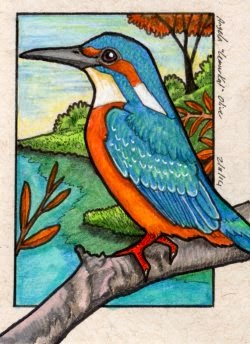
Creature Feature #379: Kingfisher

There are numerous species of Kingfisher, characterised by their colourful plumage, dagger-like bills, short tails and quick darting flight. He is a sit-and-wait predator, perching, watching and waiting for prey. His eyesight is excellent, but he has limited movement in the socket and frequently turns his head. His eyes also possess a nictitating membrane to cover them underwater, allowing him to keep them open. He is excellent at determining position underwater, compensating for refraction. Although they do eat fish, Kingfishers also feed on insects, small mammals. Many species of Kingfisher live some distance from water. Nests are a short tunnel, dug into a clay banks. Some pairs excavate their own, others use natural crevices, including termite mounds.

Do you know what the biggest kingfisher is? Well, you'll get to meet him within the next week or two.

Saturday, November 1, 2014

Creature Feature #378: Kingbird


Kingbirds are ten different species from the flycatcher Family, Tyrannus. This is an Eastern Kingbird. He hunts by "hawking" - snatching his insect prey on the wing. He and his mate construct a cup-shaped nest in a tree or atop a pole. Despite being relatively small in size, the Kingbird is noted for being rather aggressive, especially towards predatory birds such as crows. This has earned his alternate name, "tyrant flycatcher". They have also been shown to recognise the eggs of the cowbird - a brood parasite - and remove these from their nests.